Category Peoples of the Ancient World (B.C. 4500 – 1 A. D.)

Ancient world peoples – the theme of this category is the history of man’s achievements as an account of the interplay of man with his environment and his fellowmen, in meeting his basic needs. Those needs include food, clothing, shelter; the maintenance of law and order; religious expression; protection of the family and the community from internal fighting and outside attack.

In the interplay of man with his environment he had to gain an understanding of that environment and then master it, because river valleys offered fertile soil, a water supply and some protection from outside enemies, hence, man developed his earliest cultures in river valleys. While achieving the basic needs outlined above, he responded to his environment in a creative manner: he learned to draw pictures, compose poetry, improve his architecture and express his emotions through music, dance and drama. As man’s knowledge increased, he learned to preserve it by imparting it to the oncoming generation and by writing it down. When the peoples of any nation had gained considerable control over their environment, had built cities and could record their achievements in writing, we say that they had achieved – civilization.

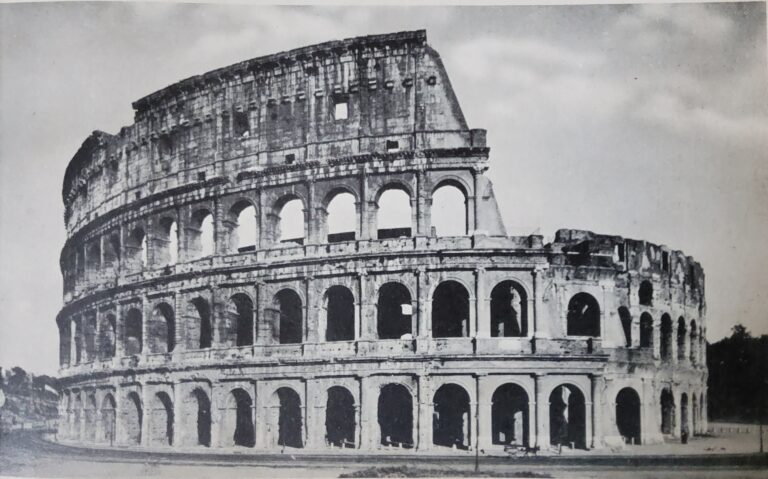
Here we deal with primitive man and the peoples of the ancient world, up to the fall of the Roman Empire in 476. The pattern by which cultures developed, sketched above, will appear and reappear over and over. Until the age of the Greeks, the major civilizations developed in the fertile river valleys of Egypt, Mesopotamia, India and China. The achievements of the Greeks were stimulated by their contacts with other cultures; their achievements were supported by the wealth they derived from trading around the Mediterranean Sea. The achievements of the Romans resulted chiefly from their absorption of the cultures of the peoples they conquered. Their development of legal codes and their feats of engineering came out of their attempts to govern a far-flung empire.

History brings out the fact that many civilizations were developed in ancient times, but a number of them have disappeared. At various places a population has studied, improvised, invented and reached a summit of achievement, then declined or been absorbed by a conquering foe. Thus, objectives for reading this history of ancient peoples may be the desire to detect the reasons why each past civilization rose and declined and which of its achievements became part of our civilization.

B.C. 4500
c.B.C. 4241 – Calendar introduced into Egypt
c.B.C. 4000 – Sumerians invade the Fertile Crescent
c.B.C. 3400 – Recorded history begins in Egypt
c.B.C. 3100 – Menes unites Egypt

B.C. 3000
c.B.C. 3000 – Cretans develop a unique civilization
c.B.C. 2500 – Development of written Cretan language
c.B.C. 2100 – Hammurabi’s Code of Laws—Babylonia

B.C. 2000
c.B.C. 2000 – Achaean invasion of Greece
c.B.C. 2000 – Dravidians establish Bronze Age in India
c.B.C. 1580 – New Kingdom begins in Egypt
c.B.C. 1350 – Hebrews move into Palestine
c.B.C. 1280 – Ramses II rules Egypt
c.B.C. 1184 – Trojan War in Aegean World
c.B.C. 1025 – Saul chosen king of the Hebrews

B.C. 1000
B.C. 776 – First recorded Olympic Games — Greece
c.B.C. 750 – Beginning of Greek colonization
c.B.C. 660 – Japanese nation founded by Jimmu Tenno
c.B.C. 550 – Birth of Confucius in China
B.C. 509 – Beginning of the Roman Republic
B.C. 483 – Death of Buddha in india
B.C. 460-429 – Periclean Age in Athens
B.C. 323 – Beginning of the Hellenistic Age
B.C. 30 – Beginning of the Roman Empire

1 A.D.
c.100 A.D. – Paper invented during the Han Dynasty — China
212 A.D. – Roman citizenship granted to all freeborn persons in the Empire
325 A.D. – Teachings of Christianity summed up in the Nicene Creed
476 A.D. – End of the Roman Empire